Research
We use ultrafast laser spectroscopy to watch what happens in materials in the first trillionths of a second after light is absorbed: how energy moves, how charges and the lattice push on each other, and how quantum coherence survives at room temperature. We work on hybrid perovskites and plasmonic–molecular hybrids, and develop new measurement tools including spectroscopy that uses entangled photons instead of classical laser light.
#1 Chirality Transfer and Chiral Light-Matter Coupling
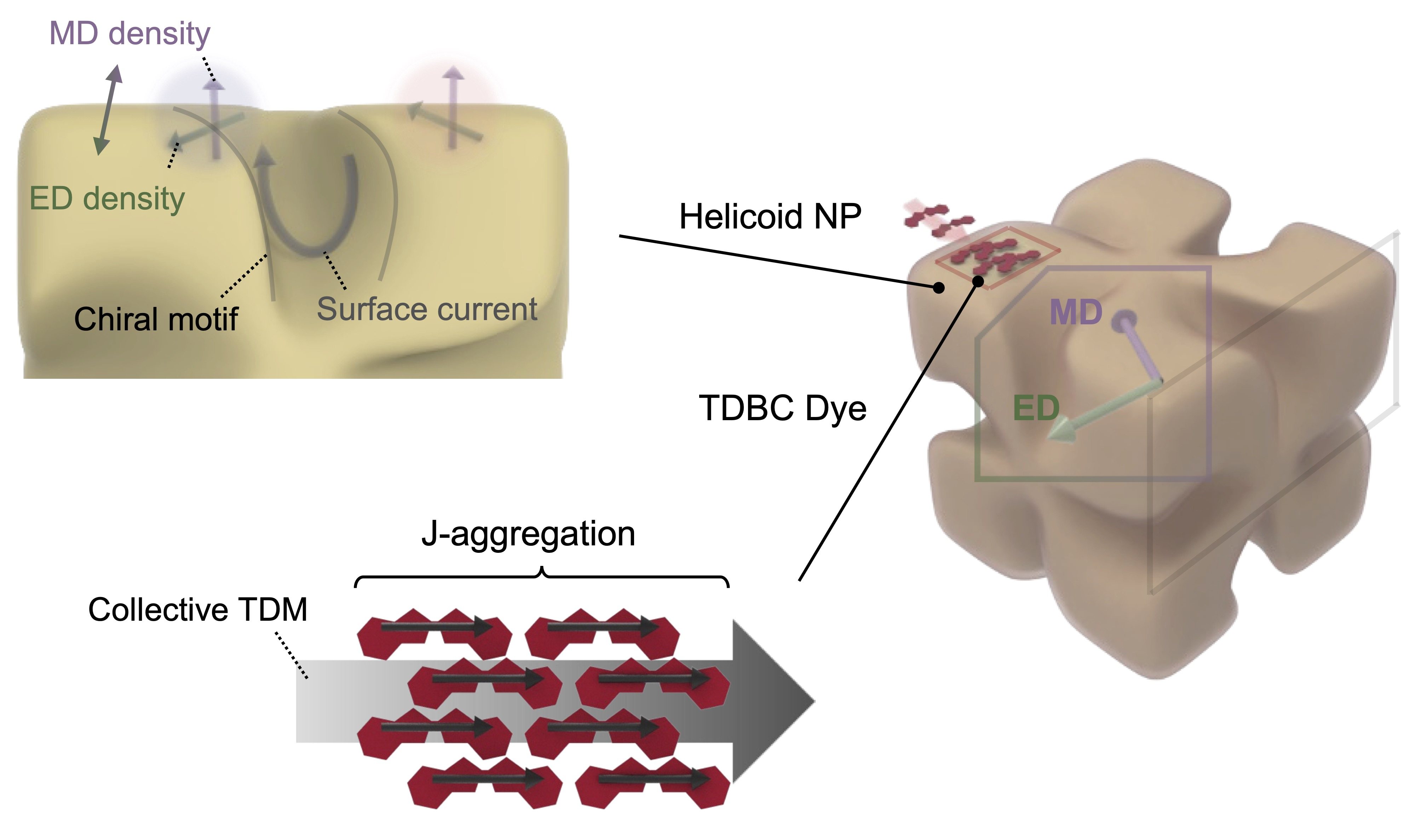
One of our current thrusts is to understand how molecular handedness imprints itself on a material’s electronic response. Comparing (R-MBA)₂PbI₄ with its racemic analogue, we found a ~5.7 meV coherent phonon that couples to excitons only in the chiral material, with a rotational displacement pattern linking spacer to Pb–I framework and providing chiral character to the exciton. In chiral gold helicoids coated with J-aggregates, we track how structural handedness and plasmon–exciton coupling steer ultrafast energy flow.
Related Materials: [Preprint (2026)] | [Preprint (2025)]
#2 Coherent phonons and Charge–Lattice Interactions
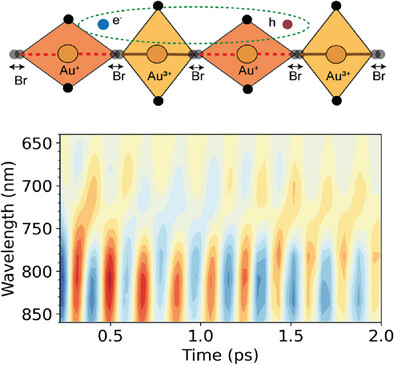
A femtosecond pulse kicks a soft ionic lattice into synchronized atomic motion that writes itself onto the optical response as an oscillation. Through Coherent Phonon Spectroscopy, we watch charges dress themselves in lattice distortion. In lead-free Cs₂Au₂Br₆ we found charge-transfer states strongly coupled to Au–Br stretching modes and an unusually slow formation of a localised state. We also found in similar tin-based systems that the formation of localised states and the strength of charge-lattice coupling depends on dimensionality, with stronger localization at lower dimensions.
Related Materials: [Paper 1] | [Paper 2]
#3 Quantum Light Spectroscopy
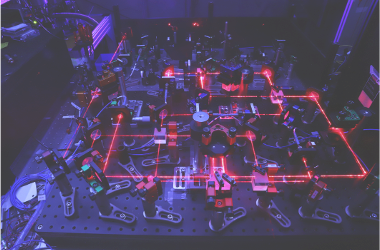
Entangled photon pairs carry time–frequency correlations no classical pulse can reproduce. We explored the use of bright entangled beams in 2D electronic spectroscopy to detect electronic, vibrational and vibronic coherences in a single snapshot, each appearing at its own point in the spectrum — separating coherence from population dynamics without temporal scanning. Separately, we used Franson interferometry to place background-free quantitative bounds on entangled two-photon absorption in dye molecules.
Related Materials: [Paper] | [Preprint (2026)]